What does CTL, ATL and TSB mean and how should I use them?

By Toby Pattullo
Australian Deaflympic marathon and ultra runner, and the solo developer behind IcuSync.
If you've opened the fitness chart in intervals.icu and wondered what those three coloured lines actually mean, you're not alone. CTL, ATL and TSB are borrowed from sports science, and the acronyms don't help much on their own. This article explains what each one represents, how they relate to each other, and how to use them to make smarter training decisions.
The basic idea: training is stress and recovery
Every workout adds stress to your body. Rest allows your body to adapt and come back stronger. CTL, ATL and TSB are simply a way to track where you are in that cycle at any given moment.
They are all calculated from your training load, which is a number that combines the duration and intensity of each session. In intervals.icu, this is typically expressed as TRIMP for heart rate-based training, or hrTSS, rTSS, or similar depending on your sport and available data.
CTL (fitness) - Chronic Training Load
What it is: Your fitness, expressed as a rolling average of training load over the past 42 days (roughly six weeks).
Think of it as: Your aerobic base. A high CTL means you have been training consistently and your body has adapted to a substantial workload.
CTL rises slowly because it takes weeks of consistent work to build real fitness. It also falls slowly. You won't lose your base overnight if you take a few easy days.
What a typical number looks like:
- A recreational runner training 4-5 hours per week might have a CTL around 40-60
- A committed amateur training 8-12 hours per week might sit around 70-100
- Elite endurance athletes can exceed 150
The number itself is less important than the trend. A CTL that has been climbing steadily over 12 weeks is a good sign. One that has been flat or declining for months suggests your fitness isn't progressing.
ATL (fatigue) - Acute Training Load
What it is: Your fatigue, expressed as a rolling average of training load over the past 7 days.
Think of it as: How hard you have been working recently. A high ATL means your body is currently under significant stress from recent training.
ATL responds much faster than CTL. A big training week will spike your ATL quickly. A few easy days will bring it back down almost as fast.
Fatigue isn't a bad thing. It is a necessary part of the adaptation process. The problem is training hard when you are already deeply fatigued without giving your body time to absorb the work.
TSB (form) - Training Stress Balance
What it is: Your form, calculated as CTL minus ATL.
The formula: TSB = CTL - ATL
Think of it as: How fresh you feel relative to your fitness. A positive TSB means you are fresher than your average workload. A negative TSB means you are carrying more fatigue than your base would normally absorb.
How to read it:
| TSB range | What it typically means |
|---|---|
| +10 to +25 | Well rested, good form, ideal for racing or hard efforts |
| 0 to -10 | Normal training zone, some fatigue, building fitness |
| -10 to -30 | Heavy training block, productive but hard |
| Below -30 | Overreaching risk, monitor closely |
These are rough guides, not hard rules. Athletes vary significantly in how much fatigue they can tolerate, and the same TSB can feel very different at CTL 50 versus CTL 100.
How the three numbers work together
The relationship between CTL (fitness), ATL (fatigue) and TSB (form) tells the story of your training cycle.
During a build phase: ATL rises faster than CTL, so TSB goes negative. You are accumulating fatigue to drive adaptation. This is intentional.
During a taper: You reduce training volume, ATL drops quickly, CTL holds most of its value, and TSB climbs toward positive. You are cashing in the fitness you have built.
After a race or time off: CTL starts to decay slowly, ATL drops to near zero, and TSB can swing strongly positive. You may feel good but your fitness base is eroding if the rest extends too long.
What this looks like in practice
Here is a real example from a Claude conversation using IcuSync. The chart shows a 60-day block leading into the Warburton 50km on March 7, followed by a controlled recovery period.
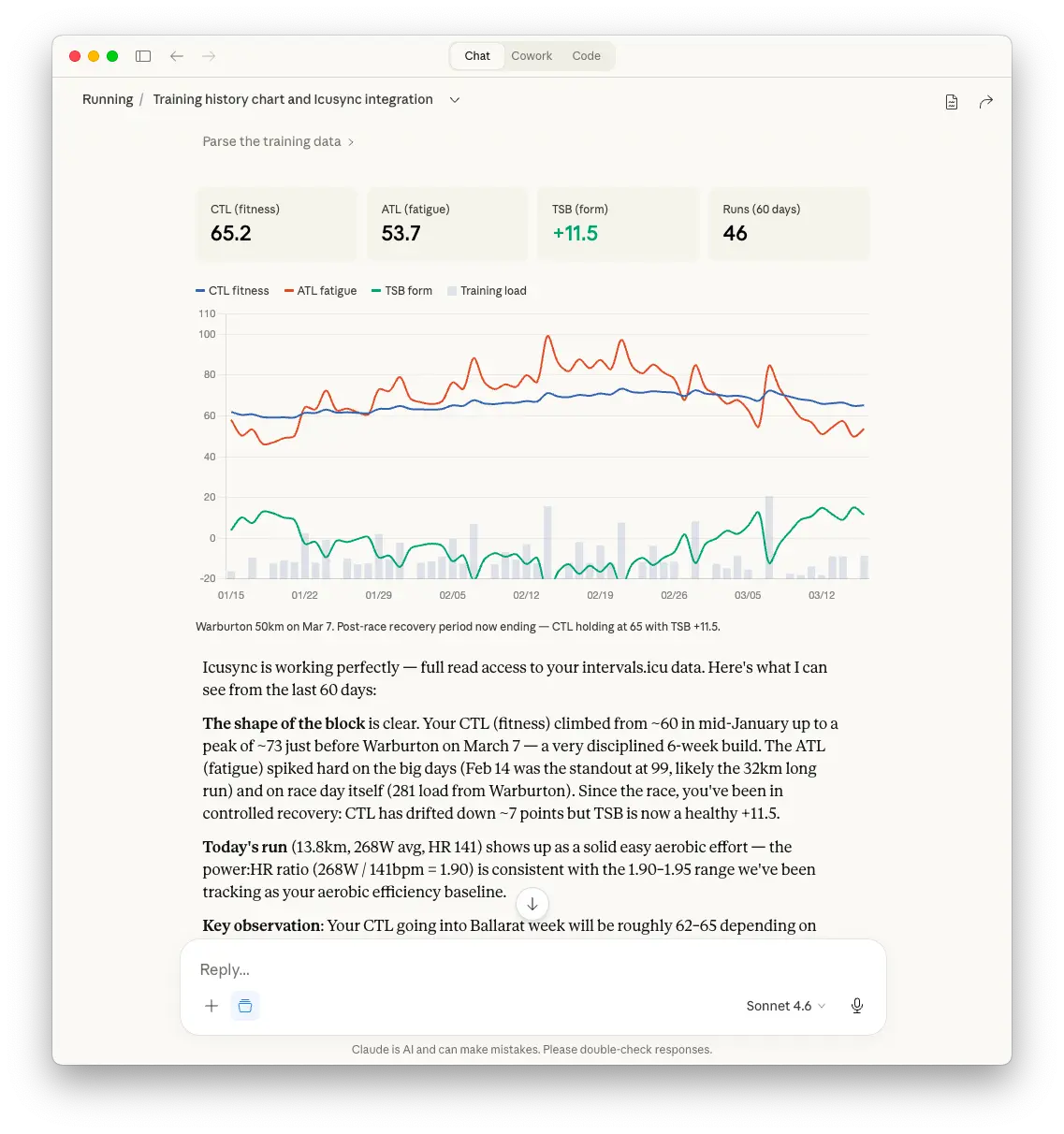
CTL (fitness) climbed steadily from around 60 in mid-January to a peak of 73 just before race day, a disciplined six-week build. ATL (fatigue) spiked hard on the biggest training days and on race day itself. Since the race, ATL has dropped back while CTL has held most of its value, pushing TSB (form) to a healthy +11.5. That is exactly what a well-executed taper and recovery period looks like on a chart.
Practical ways to use these numbers
1. Plan your taper properly
If you have a goal race in 2-3 weeks, check your TSB (form) now. If it is deeply negative (-20 or worse), you need meaningful rest to arrive at the start line fresh. If it is already around zero, a light taper week is probably enough.
2. Spot accumulated fatigue before it becomes a problem
If your TSB (form) has been below -20 for several weeks and your performance in workouts is declining rather than improving, that is a signal to take a recovery week, not push harder.
3. Understand why a workout felt terrible
A session that felt inexplicably hard often makes sense when you check ATL (fatigue) and TSB (form) after the fact. High fatigue from the previous few days can explain a lot.
4. Avoid the post-race fitness trap
After a race, your TSB (form) shoots positive and you feel great. It is tempting to train hard immediately. But your CTL (fitness) is still elevated from your build, and jumping back into hard training before your body has genuinely recovered is a common cause of injury and burnout.
5. Don't chase TSB
Some athletes become fixated on getting TSB (form) positive and end up reducing training too much, too often. Positive form is only useful if you have built the CTL (fitness) to back it up. Form without fitness doesn't win races.
Asking Claude about your numbers
If you are using IcuSync, you can ask Claude to pull your current CTL (fitness), ATL (fatigue) and TSB (form) directly from your intervals.icu data. Some useful prompts to try:
- "What's my current fitness and fatigue looking like?"
- "I have a race in 10 days. Am I in good shape to taper?"
- "My last few runs have felt terrible. What do my training load numbers say?"
- "Show me my CTL trend over the past 12 weeks."
Claude can read your actual data and give you a response grounded in your training history, not generic advice.
A note on accuracy
CTL (fitness), ATL (fatigue) and TSB (form) are models, not measurements. They are only as accurate as the training load data going into them. If your heart rate monitor has gaps, or you do a lot of untracked activity, the numbers will be incomplete. They are a useful lens on your training, not a substitute for listening to how you actually feel.
Used alongside your own perceived effort and recovery, they are a genuinely powerful tool for self-coached athletes.